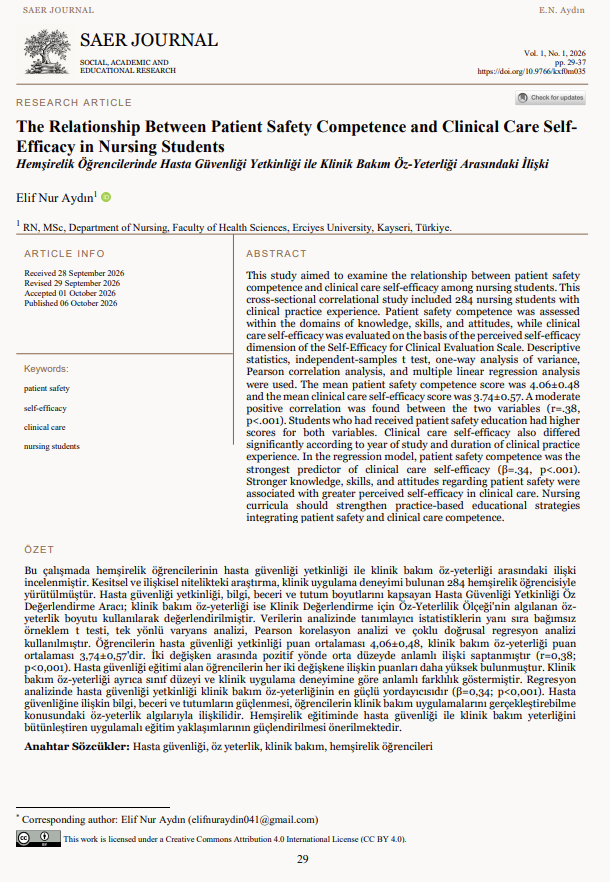
The Relationship Between Patient Safety Competence and Clinical Care Self-Efficacy in Nursing Students
DOI:
https://doi.org/10.9766/kxf0m035Keywords:
patient safety, self-efficacy, clinical care, nursing studentsAbstract
This study aimed to examine the relationship between patient safety competence and clinical care self-efficacy among nursing students. This cross-sectional correlational study included 284 nursing students with clinical practice experience. Patient safety competence was assessed within the domains of knowledge, skills, and attitudes, while clinical care self-efficacy was evaluated on the basis of the perceived self-efficacy dimension of the Self-Efficacy for Clinical Evaluation Scale. Descriptive statistics, independent-samples t test, one-way analysis of variance, Pearson correlation analysis, and multiple linear regression analysis were used. The mean patient safety competence score was 4.06±0.48 and the mean clinical care self-efficacy score was 3.74±0.57. A moderate positive correlation was found between the two variables (r=.38, p<.001). Students who had received patient safety education had higher scores for both variables. Clinical care self-efficacy also differed significantly according to year of study and duration of clinical practice experience. In the regression model, patient safety competence was the strongest predictor of clinical care self-efficacy (β=.34, p<.001). Stronger knowledge, skills, and attitudes regarding patient safety were associated with greater perceived self-efficacy in clinical care. Nursing curricula should strengthen practice-based educational strategies integrating patient safety and clinical care competence.
References
Abu Sharour, L., Bani Salameh, A., Suleiman, K., Subih, M., EL-hneiti, M., AL-Hussami, M., Al Dameery, K., and Al Omari, O. (2022). Nurses’ self-efficacy, confidence and interaction with patients with COVID-19: A cross-sectional study. Disaster Medicine and Public Health Preparedness, 16, 1393–1397. doi:10.1017/dmp.2021.1
Balat Çalbay, R., and Özbay, H. (2025). Hemşirelik ve ebelik öğrencilerinin hasta güvenliği yetkinliğine ilişkin öz-değerlendirme düzeyleri ile tıbbi hataya yönelik tutumları arasındaki ilişki. Artuklu Health, 13, 37–46. doi:10.58252/artukluhealth.1747403
Bandura, A. (1997). Self-efficacy: The exercise of control. New York, NY: W. H. Freeman.
Bianchi, M., Bressan, V., Cadorin, L., Pagnucci, N., Tolotti, A., and Valcarenghi, D. (2016). Patient safety competencies in undergraduate nursing students: A rapid evidence assessment. Journal of Advanced Nursing, 72(12), 2966–2979. doi:10.1111/jan.13033
Bu, M., Ma, H., Zhai, H., Ma, Y., and Xu, N. (2022). Role of self-efficacy in nursing organizational climate: A way to develop nurses' humanistic practice ability. Journal of Nursing Management, 30(7), 2107–2115. doi:10.1111/jonm.13516
Caruso, R., Pittella, F., Zaghini, F., Fida, R., and Sili, A. (2016). Development and validation of the nursing profession self-efficacy scale. International Nursing Review, 63(3), 455–464.
Clark, M. C., Owen, S. V., and Tholcken, M. A. (2004). Measuring student perceptions of clinical competence. Journal of Nursing Education, 43, 548–554.
Eskici, G. T., Kanig, M., Ugur, E., and Seren, A. K. H. (2021). The Turkish version of the patient safety competency self-evaluation tool: A validity and reliability study. Nurse Education in Practice, 103229. doi:10.1016/j.nepr.2021.103229
Fırat Kılıç, H., and Cevheroğlu, S. (2023). Patient safety competencies of nursing students. Nurse Education Today, 121, 105666. doi:10.1016/j.nedt.2022.105666
Glarcher, M., and Vaismoradi, M. (2025). A systematic integrative review of specialized nurses' role to establish a culture of patient safety: A modelling perspective. Journal of Advanced Nursing, 81(9), 5248–5263.
Huang, F. F., Shen, X. Y., Chen, X. L., He, L. P., Huang, S. F., and Li, J. X. (2020). Self-reported confidence in patient safety competencies among Chinese nursing students: A multi-site cross-sectional survey. BMC Medical Education, 20(1), 32. doi:10.1186/s12909-020-1945-8
Lee, S. E., Lee, M. H., Peters, A. B., and Gwon, S. H. (2020). Assessment of patient safety and cultural competencies among senior baccalaureate nursing students. International Journal of Environmental Research and Public Health, 17(12), 4225. doi:10.3390/ijerph17124225
Mihdawi, M., Al-Amer, R., Darwish, R., Randall, S., and Afaneh, T. (2020). The influence of nursing work environment on patient safety. Workplace Health & Safety, 68(8), 384–390.
Mutlu, B., Azak, M., and Kalaycı, S. (2020). Çocuk sağlığı ve hastalıkları hemşireliği dersini almış öğrencilerin klinik rahatlık ve endişe durumu ile öz yeterlilik algısı arasındaki ilişkinin incelenmesi. OPUS Uluslararası Toplum Araştırmaları Dergisi, 15(26), 4294–4312. doi:10.26466/opus.659694
Shorey, S., and Lopez, V. (2021). Self-efficacy in a nursing context. In G. Haugan and M. Eriksson (Eds.), Health promotion in health care—Vital theories and research (pp. 145–158). Cham, Switzerland: Springer. doi:10.1007/978-3-030-63135-2_12
Svitlica, B. B., Šajnović, M., Simin, D., Ivetić, J., and Milutinović, D. (2021). Patient safety: Knowledge and attitudes of medical and nursing students: Cross-sectional study. Nurse Education in Practice, 53, 103089. doi:10.1016/j.nepr.2021.103089
Vaismoradi, M., Tella, S., Logan, P. A., Khakurel, J., and Vizcaya-Moreno, F. (2020). Nurses’ adherence to patient safety principles: A systematic review. International Journal of Environmental Research and Public Health, 17(6), 2028.
Xie, D., Zhu, X., Zhang, X., Jiang, Z., Wang, X., and Liu, T. (2024). Research on the correlation between clinical nurses’ self-efficacy, future time perspective, and occupational burnout. Frontiers in Public Health, 12, 1363450.
Zengin, N., Pınar, R., Çil Akıncı, A., and Yıldız, H. (2014). Psychometric properties of the self-efficacy for clinical evaluation scale in Turkish nursing students. Journal of Clinical Nursing, 23(7–8), 976–984. doi:10.1111/jocn.12257